More contracts, forms, and approvals now get signed on a screen, not on paper. That raises a fair question: are electronic signatures legally binding? In most cases, yes. This article explains what an electronic signature is and which laws back it up. It also covers when one may not be enough and how to keep signed files safe. It is general information, not legal advice. Talk to a lawyer about anything with high stakes.
What Is an Electronic Signature?
An electronic signature is any mark you make on a screen to agree to a document. It can be a typed name. It can also be a signature drawn with your finger, a click on an "I agree" box, or a scan of your handwritten name. How it looks does not matter much. What matters is that the person meant to sign.
Most of us use them every day. Accepting terms in an app, signing for a parcel, and okaying a lease online all count.
The Electronic Signature Laws That Make Them Count
In the US, two laws do most of the work. The ESIGN Act became federal law in 2000. It says a contract can't be thrown out just because it was signed on a screen. A second law, called UETA, says much the same for each state. Almost every state uses it, and New York has its own similar law.
Other countries have rules like these. The EU uses a law called eIDAS, and the UK keeps its own version of it. Canada, Australia, and many others have their own electronic signature laws too.
| Region | Main Law | What It Says |
|---|---|---|
| United States (federal) | ESIGN Act, 2000 | Signing on a screen counts like signing on paper |
| United States (states) | UETA, used by almost every state | Sets the same rule for deals under state law |
| European Union | eIDAS | Sets out three levels of e-signature |
| United Kingdom | UK eIDAS and contract law | Accepts e-signatures in most cases |
What Makes an E-Signature Hold Up
A signature is only as strong as the proof behind it. Courts often look for four things:
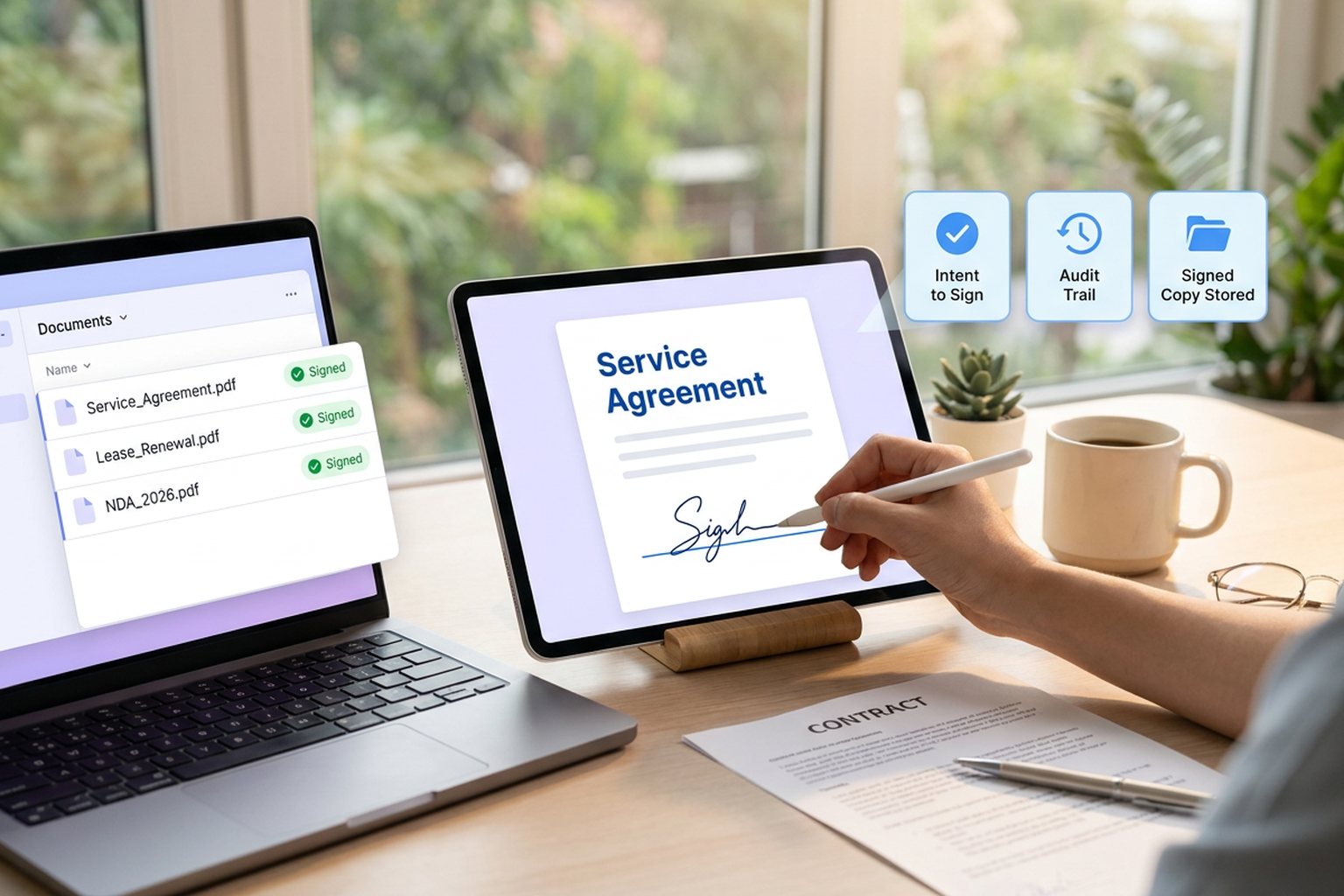
- Intent to sign. The person meant to agree, not just to open the file.
- Consent to go digital. Both sides said yes to signing on a screen.
- A clear link to the file. The signature is tied to the exact copy that was signed.
- A copy you can keep. The signed file can be saved and shown again later.
Many signing tools also keep an audit trail. It shows who signed, when, and from which email. That helps a lot if someone later says they never signed.
Electronic Signature vs. Digital Signature
People mix these two up a lot. An electronic signature is the broad idea. It is any mark on a screen that shows you agree. A digital signature is one kind, and a more technical one. It uses a coded certificate to prove who signed. It also shows if the file was changed later.
Every digital signature is an electronic signature. But most electronic signatures are not digital ones. For everyday business deals, a simple e-signature is usually fine.
When a Screen Signature May Not Be Enough
The ESIGN Act leaves out some papers. Rules vary by state and country. But these often still need paper, a pen-and-ink signature, or extra steps:
- Wills, codicils, and trusts set up in a will
- Divorce, adoption, and other family law papers
- Court orders and official court notices
- Notices to cut off utilities, evict, or foreclose
- Some insurance and product recall notices
Some papers also need a notary or witnesses. Many states now let notaries work online, but the rules differ. Check first.
A Common Scenario
A small marketing agency sends a new client a service agreement. The client signs it on a phone in two minutes. The signing tool then emails both sides a final PDF. Six months later, the client argues about the payment terms. The agency opens the signed copy and its audit trail. It shows the client's email, the date, and the exact version signed. One short call settles it.
Where Software Fits In
A signing tool handles the signature. The part people forget is what comes next. The signed copy and its audit trail need a safe home. The right people should be able to find them years later. DocuStacker keeps signed papers in one place, with access set by role and old versions kept. To learn more about handling deals after they are signed, see our guide to managing contracts digitally.
The Bottom Line
Are electronic signatures legally binding? For most business papers, yes. The ESIGN Act, UETA, and similar laws around the world back them up. Make sure the signer meant to sign and both sides agreed to go digital. Then store the signed copy safely. For wills, family law papers, and other special cases, check the rules first.