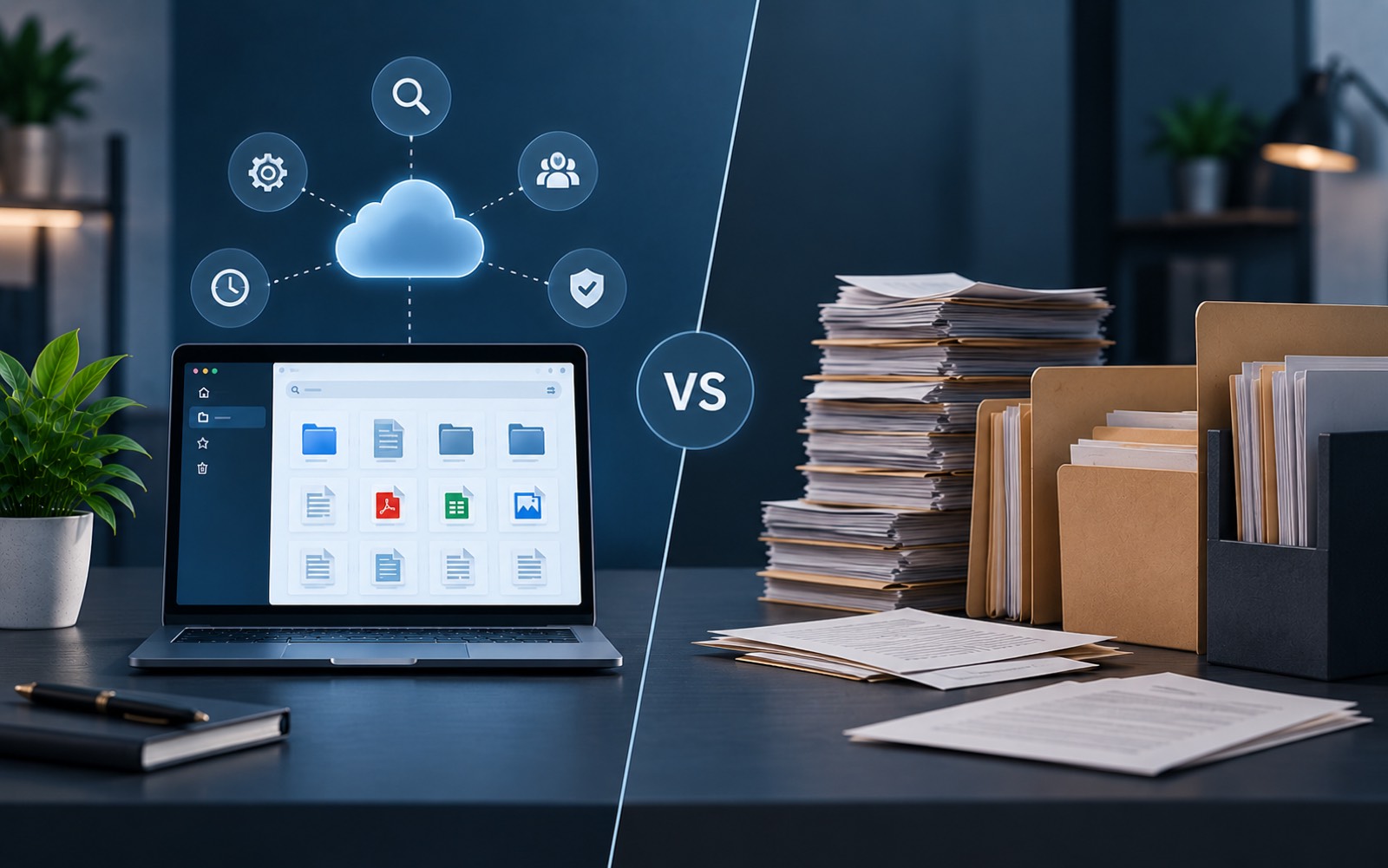

Document management costs vary a lot, and any number quoted without context isn't very useful. This article isn't going to invent a specific price, since costs differ by provider and by what a business actually needs. Instead, it explains what typically drives DMS pricing, so you can judge any specific quote you receive with more context.
What Usually Drives the Price
Number of Users
Most document management pricing scales with how many people need access. A five-person team and a fifty-person team are rarely priced the same way, since more users generally means more storage, more activity, and more support.
Storage Volume
How many documents, and how large they are, affects cost. A business scanning thousands of pages of paper records into PDFs will typically need more storage than one handling mostly short digital contracts.
Feature Level
Basic storage and search cost less than a system with detailed access control, version history, and workflow automation. It's worth being clear about which features your business actually needs, rather than paying for a tier built around features you won't use.
Support and Onboarding
Some of the cost isn't the software itself. It's the time it takes to set it up and get a team using it consistently. This is often underestimated when comparing prices side by side.
Contract Length and Commitment
Some providers price lower in exchange for a longer contract commitment. Others offer month-to-month pricing at a slightly higher rate. Neither is automatically better. It depends on how confident a business feels locking in a system before fully testing it against daily use.
A Simple Way to Frame Any Quote
| Question | Why It Matters |
|---|---|
| What's included at this price? | Avoids paying extra later for features assumed to be standard |
| How does price change as we grow? | Prevents surprise cost jumps at higher usage |
| Is support included, or billed separately? | Support often matters most in the first few months |
| What does migrating existing files cost? | Sometimes a separate, easily missed line item |
What's Being Compared To
Document management costs make more sense once compared to the actual alternative, which usually isn't "free." The alternative is typically some mix of:
- Staff time spent searching for files manually
- Risk from documents with unclear or overly broad access
- Mistakes caused by outdated versions of a document
- The cost of physical storage, if paper records are still involved
None of these show up as a clean line item, which is exactly why they're easy to underestimate when weighing document management costs against doing nothing.
Questions Worth Asking When Comparing Pricing
- Does the price scale by user, by storage, or both?
- Are access control and version history included, or an added cost?
- Is there a separate cost for migrating existing documents in?
- What happens to pricing as the business grows?
Small Businesses vs. Larger Teams
Cost considerations often look different depending on business size. A small business usually wants predictable, straightforward pricing without a long list of add-ons to configure. A larger organization may be willing to pay more for deeper customization and support. Neither approach is wrong. It depends on what the business actually needs day to day. DocuStacker's document management for small businesses is built around the first case: clear value without unnecessary complexity.
The Hidden Cost of Staying With "Free"
It's worth naming the option that often gets left out of a cost comparison entirely: sticking with folders, email attachments, and free general storage. That option has no invoice, but it isn't free. Staff time spent searching, mistakes from outdated versions, and risk from loose access control all carry a real cost. It just never appears as a monthly charge.
This doesn't mean every business should pay for document management software immediately. It means "free" and "no cost" aren't quite the same thing, and it's worth being honest about which one actually applies.
How to Evaluate a Quote
Rather than comparing prices in isolation, it helps to compare the total picture. Look at the price, what's included at that price, and how much manual work would still be required after setup. A cheaper system that leaves organization and access control mostly manual may cost more in staff time than a system priced higher but built to handle those tasks automatically.
It also helps to be realistic about how long a quote stays relevant. A price that looks attractive for a five-person team can look very different once that team doubles. Asking how pricing scales, not just what it costs today, avoids an unpleasant surprise a year down the line.
For specific numbers, DocuStacker's own DocuStacker pricing page lays out plan details directly. That's generally the most reliable way to evaluate cost: against a real, current price list, rather than an industry average that may not reflect any specific product.
The Bottom Line
Document management costs vary for good reason: team size, document volume, and required features all differ from one business to the next. Rather than chasing a single average number, it's more useful to compare a specific quote against the specific problems it would actually solve for your business.